
 2 hours ago
3
2 hours ago
3
This year has been a tough ride for Cardano (ADA) investors, as weakening retail participation collides with renewed development activity and aggressive accumulation by large holders.
Related Reading: Bitcoin Capitulation Or Buy Zone? What On-Chain Data Shows Right Now
While on-chain data points to growing long-term conviction, market sentiment around ADA remains fragile, leaving the asset caught between technical pressure and ecosystem expansion efforts.
Cardano sits at #11 trading near $0.28 after a sharp correction from January highs above $0.44. The price structure reflects broader cooling across the market, with declining derivatives activity and cautious trader positioning reinforcing analysts’ description of a “survival mode” environment for the token.
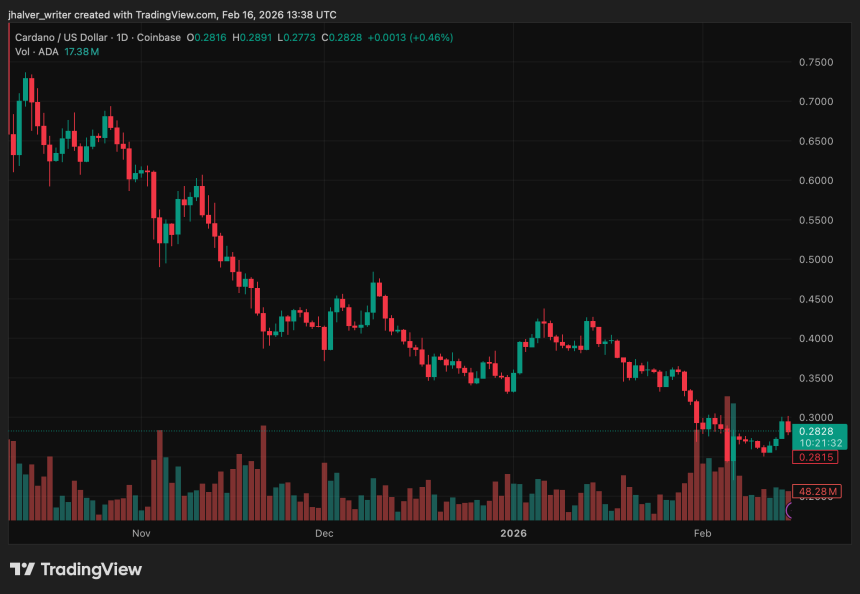
Market Fatigue Weighs on Cardano (ADA) Price Momentum
Cardano founder Charles Hoskinson recently warned that the crypto market could face another 90 to 180 days of slow conditions, citing retail exhaustion following years of market shocks, including exchange failures, regulatory uncertainty, and repeated speculative cycles.
Derivatives data support this cautious outlook. Open interest in ADA futures has dropped to roughly $447 million, alongside declining trading volumes, signaling reduced conviction among traders. Funding rates have also turned negative, suggesting bearish sentiment is building in leveraged markets.
Technically, ADA is testing key support levels. The token continues to defend an ascending trendline formed after February’s lows near $0.22, while resistance remains clustered around the $0.29–$0.30 region.
Analysts note that repeated tests of support increase the risk of breakdown, potentially exposing downside targets near $0.25 if selling pressure intensifies. Despite the weakness, higher-low formations and stabilization above short-term moving averages leave room for recovery should broader market sentiment improve.
Whales Step In as Retail Interest Declines
While retail demand fades, large holders appear to be taking the opposite approach. On-chain data shows wallets holding between 10 million and 100 million ADA accumulated more than 220 million tokens, valued at over $61 million, during the recent price dip.
The Mean Coin Age metric has reached a three-month high, indicating long-term holders are largely refraining from selling. Historically, this combination of whale accumulation and reduced token movement can tighten circulating supply and help establish price floors during downturns.
Some analysts argue that February’s lows could represent a longer-term entry zone if market conditions stabilize, though they caution that historical rebounds do not guarantee future performance.
DeFi Expansion Plans Aim to Shift NarrativeBeyond price action, Cardano is advancing with ecosystem upgrades to strengthen its decentralized finance (DeFi) ecosystem. The network plans to launch USDCx, a USDC-backed stablecoin intended to address liquidity shortages that have limited DeFi growth on the chain.
In parallel, Cardano is integrating the LayerZero interoperability protocol, enabling connections to more than 140 blockchain networks, including Ethereum and Solana. The move is expected to expand cross-chain liquidity access and attract developers seeking broader user bases.
Related Reading: Ethereum Staking Reaches Historic Levels, Price Hovers Near $2K
Development activity remains high, with hundreds of repository updates focused on wallet improvements, cross-chain communication, and network infrastructure. However, market reaction has so far remained muted, suggesting investors are waiting for measurable adoption rather than announcements alone.
Cover image from ChatGPT, ADAUSD chart on Tradingview











 English (US) ·