
 1 hour ago
4
1 hour ago
4
Bitcoin’s recent price decline has led to many traders betting on further downside, with on-chain data showing a notable increase in bearish positioning across major crypto exchanges. According to on-chain data from Santiment, aggregated funding rates have fallen into deep negative territory.
This level of deep short positioning has not been seen with Bitcoin since August 2024, a period that ultimately established a major bottom before a powerful multi-month recovery. Bitcoin traders are now back to this level, and history shows that such extreme positioning can create the conditions for a rally.
Funding Rates Show Bearish Positioning For Bitcoin
Santiment’s “Funding Rates Aggregated By Exchange” metric blends funding data from multiple major exchanges to provide a good view of market sentiment and positioning pressure across the crypto industry.
Funding rates are a mechanism used in perpetual futures markets where traders pay small fees to one another at regular intervals to keep contract prices aligned with spot prices. When funding rates are negative, short sellers are paying long traders. When they are positive, longs are paying shorts.
The latest chart data from Santiment shows funding rates are now in negative territory, with red bars dominating the lower section of the chart. Funding rates are now less than -0.01%, which shows that a significant portion of derivatives traders are positioned for downside.
More often than not, funding rates are positive, as shown in the chart below. According to Santiment, the last time derivatives funding reached similarly extreme negative levels was in August 2024.
At that time, traders were shorting Bitcoin aggressively after a notable price crash. However, instead of continuing lower, the Bitcoin price action reversed sharply. Short liquidations helped contribute to an approximately 83% rally over the following four months as positions were forced to close.
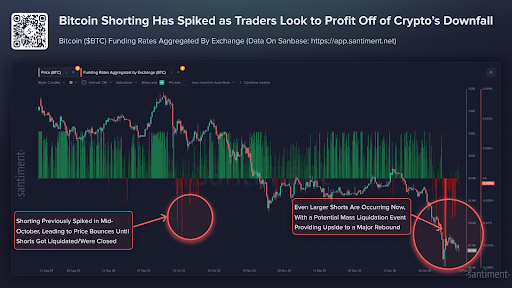
A similar setup occurred after Binance’s major liquidation event on October 10, 2025, when billions of dollars in long positions were wiped out. In the aftermath, traders turned sharply bearish and crowded into short positions.
Extreme Shorting Can Lead To A Squeeze
Extreme negative funding is a reflection of fear-based positioning. All that needs to happen for a short squeeze is for the Bitcoin price to push just a bit higher.
If the price unexpectedly moves higher, leveraged shorts begin accumulating losses at a fast pace. Once those losses cross liquidation thresholds, exchanges automatically close those positions. Traders must buy back Bitcoin to cover their positions, and this, in turn, creates upward pressure on the price.
At the time of writing, Bitcoin is trading at $68,740, but the short-term cost basis is around $90,900. A strong push and close above $75,000 could lead to bullish momentum and draw in fresh inflows, increasing the chances of a short squeeze. However, heavy shorting alone does not guarantee an immediate rebound, though it does create a fragile environment where positioning pressure can quickly change to sharp upside volatility.








 English (US) ·