
 2 hours ago
2
2 hours ago
2
Strive Asset Management Chief Strategy Officer Avik Roy said Michael Saylor has effectively “struck oil” with STRC, arguing that Strategy’s latest preferred equity structure has opened a powerful new funding channel for Bitcoin accumulation.
Speaking with The Bitcoin Historian, Roy cast STRC not as just another capital raise, but as a product design breakthrough for Strategy’s treasury model. In his telling, the significance is less about a new ticker and more about what it could unlock: a deeper pool of yield-seeking capital that can be recycled into additional BTC purchases.
Saylor Found A New Funding Engine For Bitcoin
Roy’s argument rested on how Strategy has evolved its financing playbook over time. He said the company first used common equity issuance to buy BTC, then leaned into zero-rate convertible debt during the low-rate era, only to discover that convert buyers often hedged by shorting the stock. That, he argued, created an unhelpful dynamic around MSTR.
The preferred equity route, in his view, was the answer. Roy said the earlier preferred products raised some money, but not at the scale Strategy needed. STRC, by contrast, was designed to stay close to its $100 share price while offering a dividend yield that he said was “somewhere like 12% right now,” making it a more legible product for investors who want yield with limited downside volatility.
“I think of it like striking oil,” Roy said. “You discover oil and the oil just gushes out. And that’s kind of what they’ve identified here is they’ve identified something that really has a lot of financial power to it. And it’s still so early.”
That metaphor sat at the center of the interview. Roy’s point was not that STRC replaces BTC, but that it gives Strategy a more scalable way to bring traditional capital into a Bitcoin treasury strategy. He compared STRC to a stable-value instrument for brokerage accounts, saying investors who do not want direct Bitcoin volatility may still find the structure attractive if it holds near par and keeps paying income.
He went further, arguing that this is how Bitcoin begins to reshape the financial system from the inside. “What Strive and Strategy and these kinds of companies are doing is actually it’s because they understand what Bitcoin’s value is as collateral that they’re building credit on top of that,” Roy said. “They’re using Bitcoin as the virus to infect traditional finance. This is very very good for Bitcoin and very very good for the people who have a stake in the traditional finance sector as well.”
That thesis also helps explain why Roy sees STRC as more than a one-company story. If products like STRC succeed, he suggested, they could become part of a broader “digital credit” market built on BTC-heavy balance sheets. At the same time, he stressed that not every treasury company can follow Strategy’s path. The legal and banking costs involved in issuing preferred securities at scale are high, which means smaller Bitcoin treasury firms may struggle to replicate the model anytime soon.
JUST IN: $600 MILLION STRIVE CSO JUST SAID MICHAEL SAYLOR “DISCOVERED OIL” WHEN HE CREATED $STRC
STRATEGY IS USING #BITCOIN AS THE “VIRUS TO INFECT TRADITIONAL FINANCE”
“THIS IS VERY, VERY GOOD FOR BTC.”  pic.twitter.com/PioiaJkUCJ
— The Bitcoin Historian (@pete_rizzo_) March 22, 2026
Roy also tied the STRC story to a larger shift in institutional attitudes. Strategy, he said, is helping banks move toward Bitcoin not by rhetoric but by fee generation. Once banks and brokers can make money from Bitcoin-linked products, the political and regulatory climate around the asset may begin to soften as well.
Even so, he framed the model’s long-term viability around one core assumption: Bitcoin must continue appreciating over time. If that holds, STRC and similar structures could become a major engine for future treasury accumulation. If bond markets eventually begin treating Bitcoin as legitimate collateral rather than assigning it no value, Roy suggested the runway for Strategy and peers could widen considerably.
Strategy’s Bitcoin buying accelerated sharply in early March before cooling in the most recent disclosed week. In the week ended March 8, the company sold roughly $377.1 million of STRC and acquired 17,994 BTC. In the following week, ended March 15, it sold another $1.1804 billion of STRC and purchased 22,337 BTC.
But in the week ended March 22, Strategy reported no STRC issuance and bought a comparatively modest 1,031 BTC, funded by $76.5 million in net proceeds from MSTR stock sales. Across the full three-week stretch, the company accumulated 41,362 BTC, with STRC supplying about $1.56 billion of the capital behind the earlier buying wave.
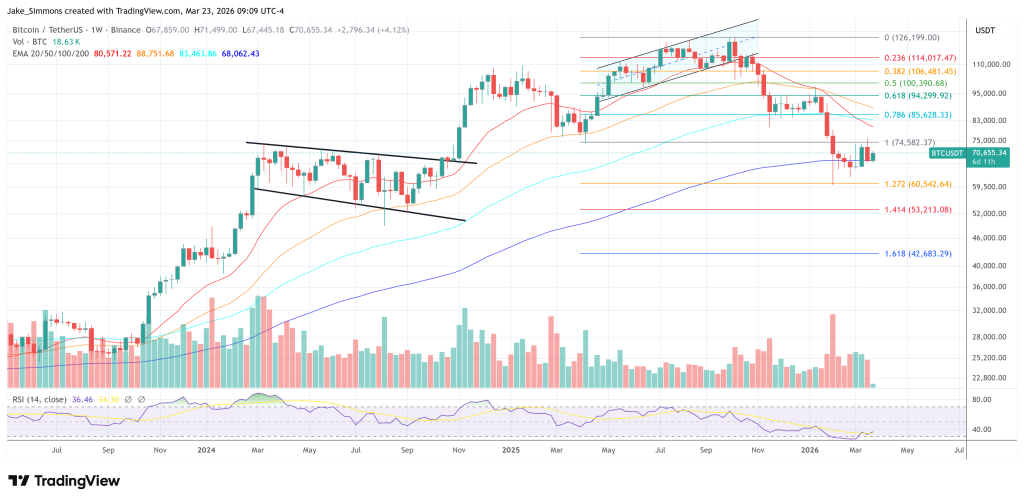
At press time, BTC traded at $70,655.













 English (US) ·