
 2 hours ago
4
2 hours ago
4
The regulatory outlook for Ethereum is gaining renewed attention following signals from Paul Atkins, who has reportedly informally characterized the digital asset as a non-security digital commodity. This development marks a potentially significant shift in how US regulators view ETH’s legal status, offering greater clarity for investors, institutions, and the broader cryptocurrency industry.
What A Non-Security Label Means For Ethereum
The US Securities and Exchange Commission (SEC) Chairman Paul Atkins has already informally described Ethereum as a non-security digital commodity. An investor and commentator, Paul Barron, has revealed on X that this new fast-track proposal for tokenized securities is positioning ETH not just merely as a coin, but as the foundational settlement layer for the world’s new on-chain financial system.
This shift suggests that ETH could play a central role in tokenizing traditional financial instruments, including bonds and real-world assets (RWAs). However, if regulatory innovation exemptions materialize, the market could see a surge in tokenized securities and real-world asset projects moving to the ETH mainnet.
Ethereum was once the get-rich-quick asset that turned early holders into millionaires overnight. A full-time stock investor and founder of the TD Indicator StockTrader Max pointed out that ETH has evolved into a long-term value investment with lower, steadier growth that rewards patience and conviction rather than hype and timing.
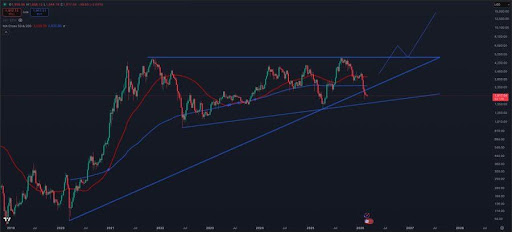
StockTrader Max argues that investors who own ETH and expect immediate profits over weeks or months may find the current market environment disappointing, because ETH is an asset that should be held in many portfolios with a time horizon of years, not just months.
From a technical perspective, Max highlights that the accumulation zone has continued to grow. Meanwhile, if ETH breaks out of this 5-year accumulation zone, the price will surge, and participants will wish they accumulated from this current level below the 200-week moving average (200 WMA).
Understanding Ethereum’s Civilizational Role In Digital Finance
Investors should stop focusing on what Vitalik Buterin sells or says. According to blockchain author and investor William Mougayar, Ethereum is infrastructure and civilizational, and its trajectory does not hinge on any single individual portfolio activity or commentary.
While Vitalik plays a meaningful role in shaping discourse and influencing ideas, he does not control the destiny of applications. While systemic value originates at the protocol layers where Vitalik and the Ethereum Foundation (EF) have the most pull, the monetization and new forms of value tend to emerge higher in the stack.
However, conflating base-layer infrastructure with application cycles or institutional timing, and if one individual trades can shake conviction, then the investor has fundamentally misunderstood the permissionless nature of the stack. ETH should be evaluated on its architectural inevitability, not on daily narratives.










 English (US) ·